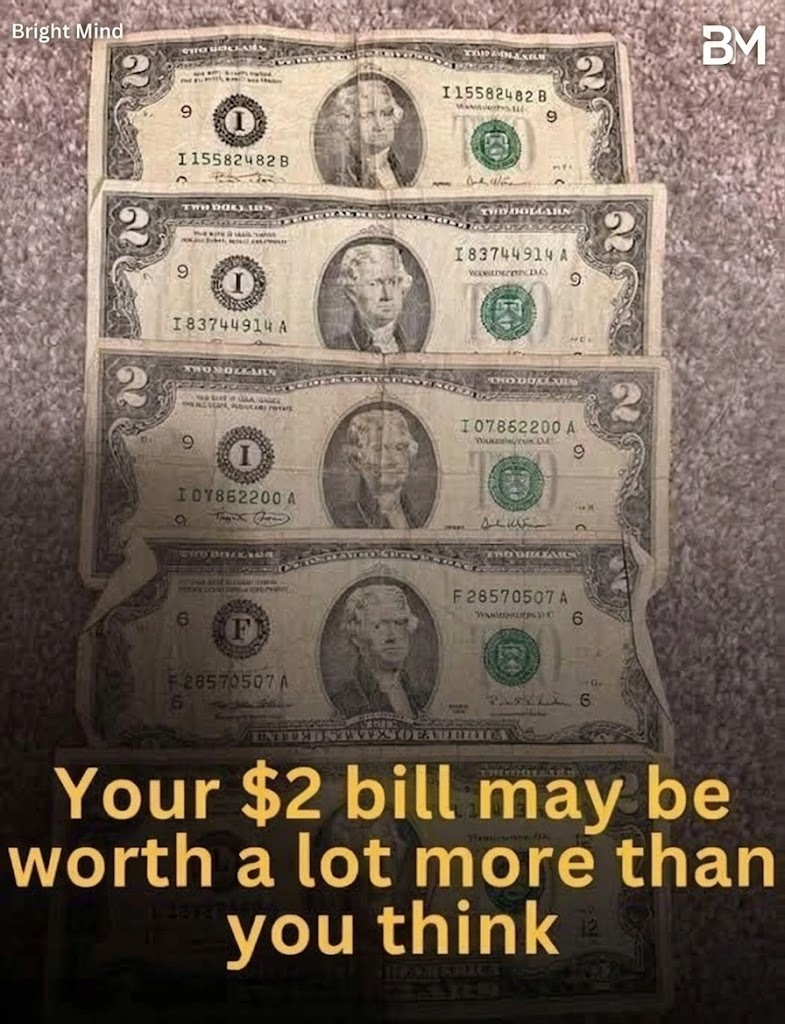
Most people barely think twice about a $2 bill.
It’s often seen as unusual, sometimes even mistaken as fake, and rarely used in everyday transactions.
Because of this, many assume it has little to no value beyond its face amount.
But that assumption isn’t always correct.
In fact, some $2 bills are quietly becoming collector favorites—and in certain cases, they can be worth far more than you’d expect.
Are $2 Bills Rare?


The $2 bill isn’t exactly rare, but it is uncommon.
Issued by the United States Bureau of Engraving and Printing, these bills are still printed today, but they’re produced in much smaller quantities than other denominations.
Because they don’t circulate as often, many people hold onto them—either out of curiosity or belief that they might be valuable someday.
And sometimes… they’re right.
What Makes a $2 Bill Valuable
Not every $2 bill is worth more than $2.
But certain features can significantly increase its value.
Collectors look for details that set one bill apart from another.
These include:
- Series year
- Treasury seal color
- Printing quality and alignment
- Unique serial numbers
Even small differences can turn an ordinary bill into something collectible.
The Importance of Serial Numbers
One of the biggest factors in determining value is the serial number.
Some patterns are especially desirable:
- Low numbers (like 00000001)
- Repeating numbers (22222222)
- Palindromes (12344321)
- Ladder sequences (12345678)
Bills with these types of serial numbers stand out because they are rare and visually striking.
To collectors, that uniqueness matters.
- https://www.money.org
- https://www.uscurrency.gov
Why Condition Matters
Condition plays a huge role in value.
A crisp, uncirculated bill—free from folds, stains, or damage—can be significantly more valuable than a worn one.
Even if two bills have identical features, the one in better condition will almost always be worth more.
That’s because collectors are looking for preservation as much as rarity.
Special Features to Look For


Beyond serial numbers and condition, there are other details that can increase value:
- Red seal bills (older series notes)
- Printing errors (misaligned or missing elements)
- Star notes (replacement bills marked with a star)
- Unusual alignment or margins
These small details are often overlooked—but they can make a big difference.
Why Collectors Love $2 Bills
Part of the appeal comes from the story behind the bill.
The $2 note has always been different.
It hasn’t been widely used, and for years, it carried a reputation as something unusual or even unlucky.
But that uniqueness is exactly what draws collectors in.
As digital payments become more common, physical currency—especially less-used denominations—begins to carry more historical and collectible value.
How to Check Your Bill Today
If you have a $2 bill, it’s worth taking a closer look.
Here’s what to check:
- Look at the year printed on the bill
- Examine the serial number pattern
- Check the condition
- Look for any printing errors or unusual features
Even if it turns out to be standard, you’ll at least know what you have.
And if it’s something rare… you might be holding more value than you realized.
Final Thoughts
The $2 bill is one of those everyday items that most people overlook.
But hidden in those small details are stories, history—and sometimes, unexpected value.
You don’t need to be a collector to take a second look.
Because sometimes, the most ordinary things turn out to be anything but.