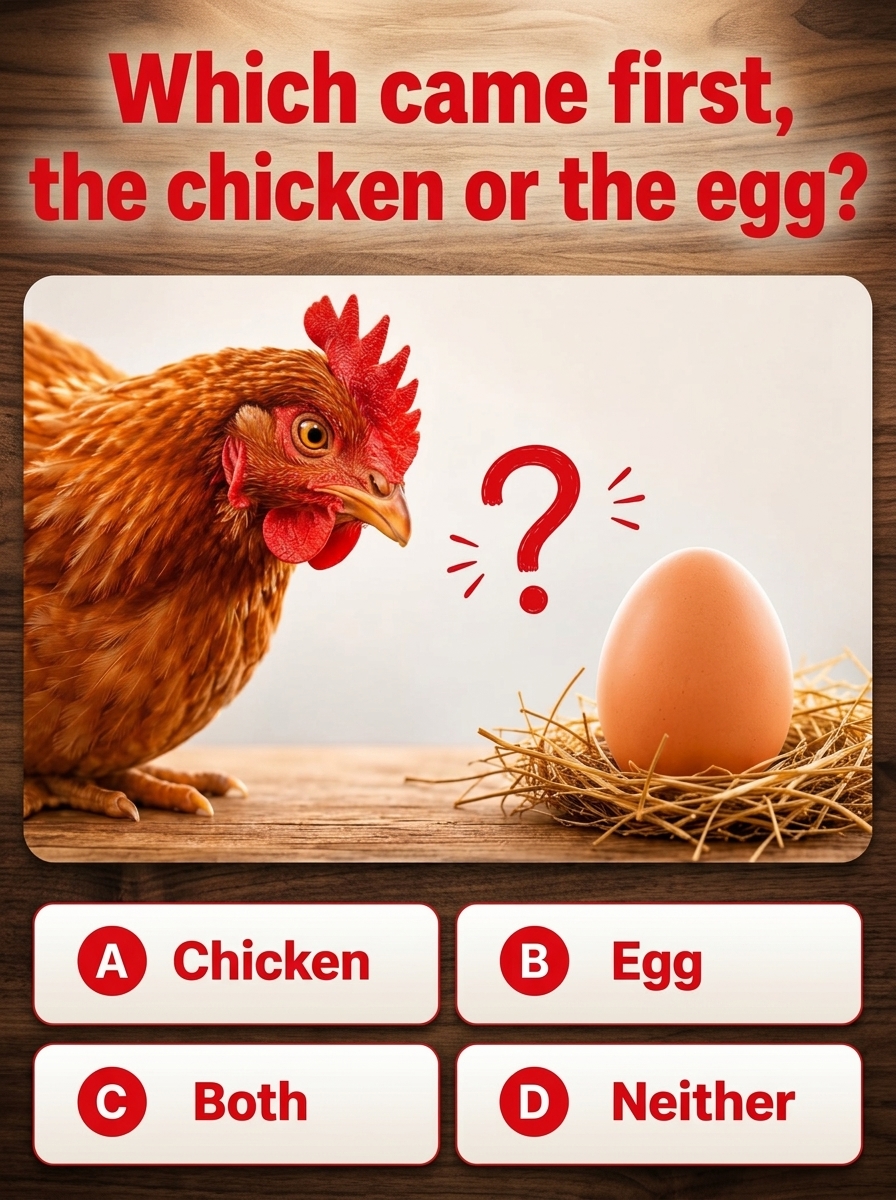
🐣 Which Came First: The Chicken or the Egg?
The age-old question “Which came first, the chicken or the egg?” has captivated human minds for millennia. Historically treated as a classic logical paradox, it was cited by ancient philosophers to illustrate infinite regresses and the cyclical nature of life.
In the modern era, advancements in evolutionary biology, genetics, and biochemistry have turned this philosophical riddle into a solved scientific puzzle. The definitive answer depends on your analytical lens, but overall, science gives the crown to the egg! 🥚
🦖 1. The Evolutionary Perspective: Why the Egg Wins
From the standpoint of evolutionary biology and genetics, the answer is clear and unconditional: the egg came first.
| Entity / Milestone | Approximate Timeframe | Evolutionary Significance |
| Amniotic Eggs | ~340 Million Years Ago | Allowed life to reproduce on dry land |
| First Birds | ~150 Million Years Ago | Evolved from theropod dinosaurs |
| Domestic Chicken | ~5,800 to 10,000 Years Ago | Domestication of wild junglefowl |
The Amniotic Egg Predates Birds
Long before birds took to the skies, early tetrapods evolved the amniotic egg — a self-contained life-support system with a hard shell. Dinosaurs were laying hard-shelled eggs hundreds of millions of years before any chicken walked the Earth.
The First “True” Chicken
When narrowing the question specifically to the chicken versus the chicken egg:
-
Ancestral Mating: Two ancestral proto-chickens (wild Junglefowl) mated.
-
Zygote Mutation: During fertilization, a small genetic mutation occurred in the single-cell zygote.
-
The First Chicken Egg: This mutated DNA formed the precise genetic blueprint of the very first true domestic chicken (Gallus gallus domesticus).
Because an animal’s DNA is set at conception, the egg containing that mutated DNA existed before the first chicken hatched from it.
🧪 2. The Biochemical Argument: The Case for the Chicken
While evolutionary biology favors the egg, a 2010 study presented a counterargument based on eggshell biochemistry:
-
Ovocleidin-17 (OC-17): This essential protein acts as a catalyst to convert calcium carbonate into the hard calcite shell within 24 hours.
-
Exclusive Production: OC-17 is produced exclusively inside a mature hen’s ovaries.
Under this strict biochemical definition — where a “chicken egg” is strictly defined as an egg made with chicken-synthesized proteins — the chicken must exist first to produce the egg shell.
🏛️ 3. Philosophical Interpretations
-
Aristotelian Teleology: Aristotle argued that potentiality requires actualization. Since an egg only holds the potential to become a bird, the actual form of the adult bird must conceptually precede the egg.
-
Problem of First Causes: Plutarch used the riddle to debate whether the universe had a definitive beginning or exists in an uncreated cycle, treating the egg as a symbol of cosmic creation.
📊 Breakdown of the Options
| Option | Scientific & Analytical Justification |
| A) Chicken | Biochemical View: OC-17 protein required for shell crystallization is only made by hens. |
| B) Egg | Evolutionary View: Amniotic eggs predated birds by 200M+ years; the first chicken hatched from a mutated egg. |
| C) Both | Systemic View: Organism and reproductive cell represent a co-evolutionary, continuous life cycle. |
| D) Neither | Microscopic View: Single-celled proto-organisms and ancestral species predated both modern chickens and shelled eggs. |
💡 Conclusion
When taking a broad view of natural history, the verdict is definitive: the egg came first. Amniotic eggs allowed animals to conquer land long before birds appeared, and the very first genetic chicken was born from an egg laid by its ancestral parents!
💬 Which perspective makes the most sense to you — the evolutionary egg argument or the biochemical chicken theory? Share your thoughts below! 👇