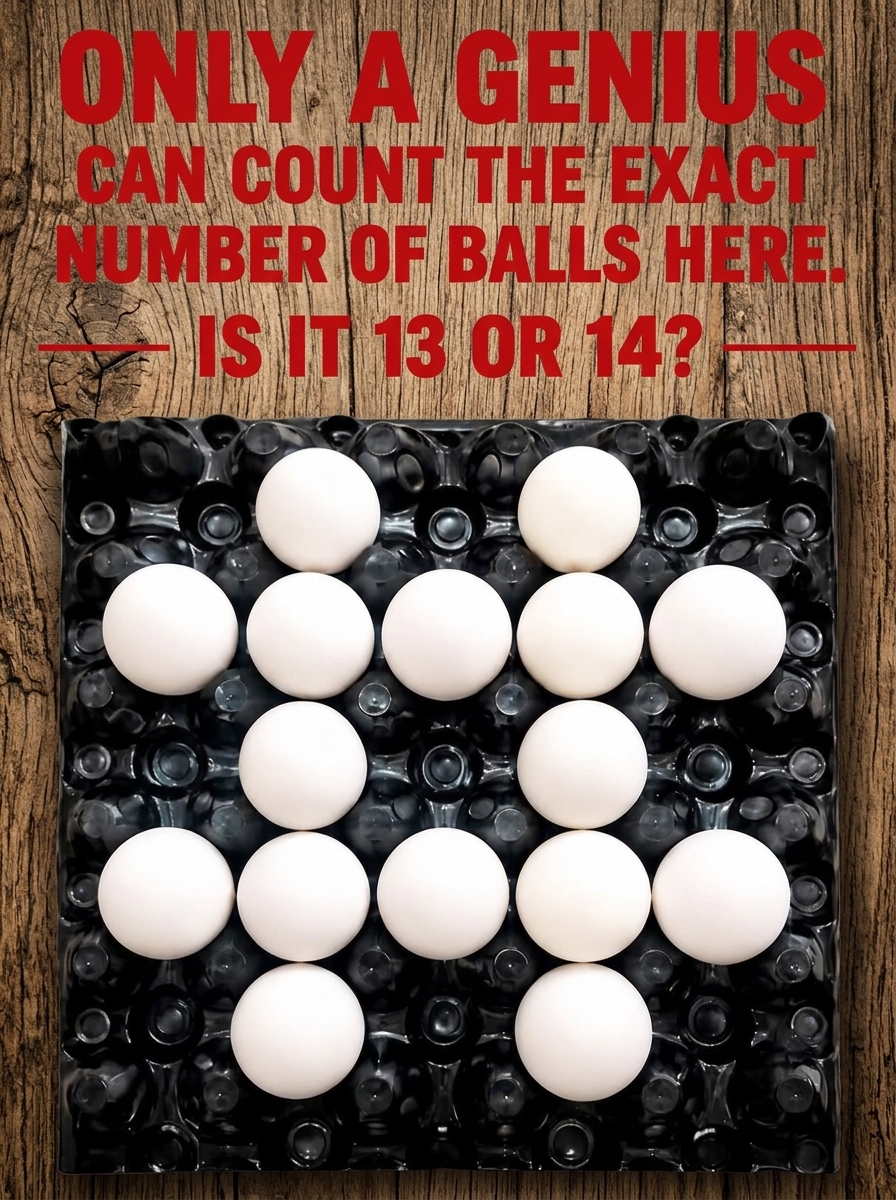
⚪ 13, 14, or something else? Count the exact number of balls in this picture!
Visual puzzles and counting challenges have exploded across social media, capturing the curiosity of millions. This viral egg tray riddle—asking whether there are 13 or 14 white spheres—is a classic example of a spatial awareness test designed to exploit human perceptual limitations.
At first glance, counting white balls seems simple. However, optical tricks, geometric patterns, and cognitive biases often cause the brain to miscount, misinterpret spatial relationships, or overlook basic structural layout.
📐 1. Mathematical and Spatial Breakdown
To solve visual counting puzzles accurately, you have to look past surface perception and analyze the underlying geometry. When broken down systematically across the $5 \times 5$ grid tray, the exact count becomes unmistakable:
| Row Position (Top to Bottom) | Visible Spheres Count | Spatial Alignment |
| Row 1 (Top) | 2 Spheres | Inner Columns (Cols 2 & 4) |
| Row 2 | 5 Spheres | Full Row (Cols 1 to 5) |
| Row 3 (Middle) | 2 Spheres | Inner Columns (Cols 2 & 4) |
| Row 4 | 5 Spheres | Full Row (Cols 1 to 5) |
| Row 5 (Bottom) | 2 Spheres | Inner Columns (Cols 2 & 4) |
Verifying the Exact Count
Summing the visible spheres across all five rows gives:
The True Answer is 16! The headline choice between “13 or 14” is a intentional cognitive distraction known as anchoring bias. By presenting two incorrect choices, the prompt tricks your brain into second-guessing basic counting and searching for hidden shadows or missing items.
🧠 2. Psychological Mechanisms Behind the Trick
Why do simple counting images generate so much debate in social feeds?
-
Anchoring Effect & Visual Priming: When asked “Is it 13 or 14?”, the brain involuntarily uses those numbers as reference points. This cognitive shortcut leads people to assume the correct answer must be one of the choices, causing them to miscount or assume certain spheres don’t count.
-
Gestalt Grouping (Law of Symmetry): The spheres form a highly balanced, cross-like symmetry. The brain naturally perceives the pattern as a single geometric shape rather than isolated units, making rapid sequential counting harder.
-
Figure-Ground Contrast: High contrast between bright white spheres and the dark plastic tray causes quick visual fatigue, increasing the likelihood of human error during a casual scroll.
💡 3. Cognitive Benefits of Visual Puzzles
Engaging with visual riddles is a great way to train your brain:
-
Systematic Visual Scanning: Trains your eyes to move methodically (row-by-row) rather than jumping around chaotically.
-
Working Memory: Sharpens your ability to hold sub-counts in mind while processing complex patterns.
-
Cognitive Flexibility: Teaches you to re-evaluate initial assumptions when a headline contradicts what your eyes actually see.
💬 Did you get 16 right away, or did the “13 or 14” headline trick your eyes at first glance? Share your answer in the comments! 👇