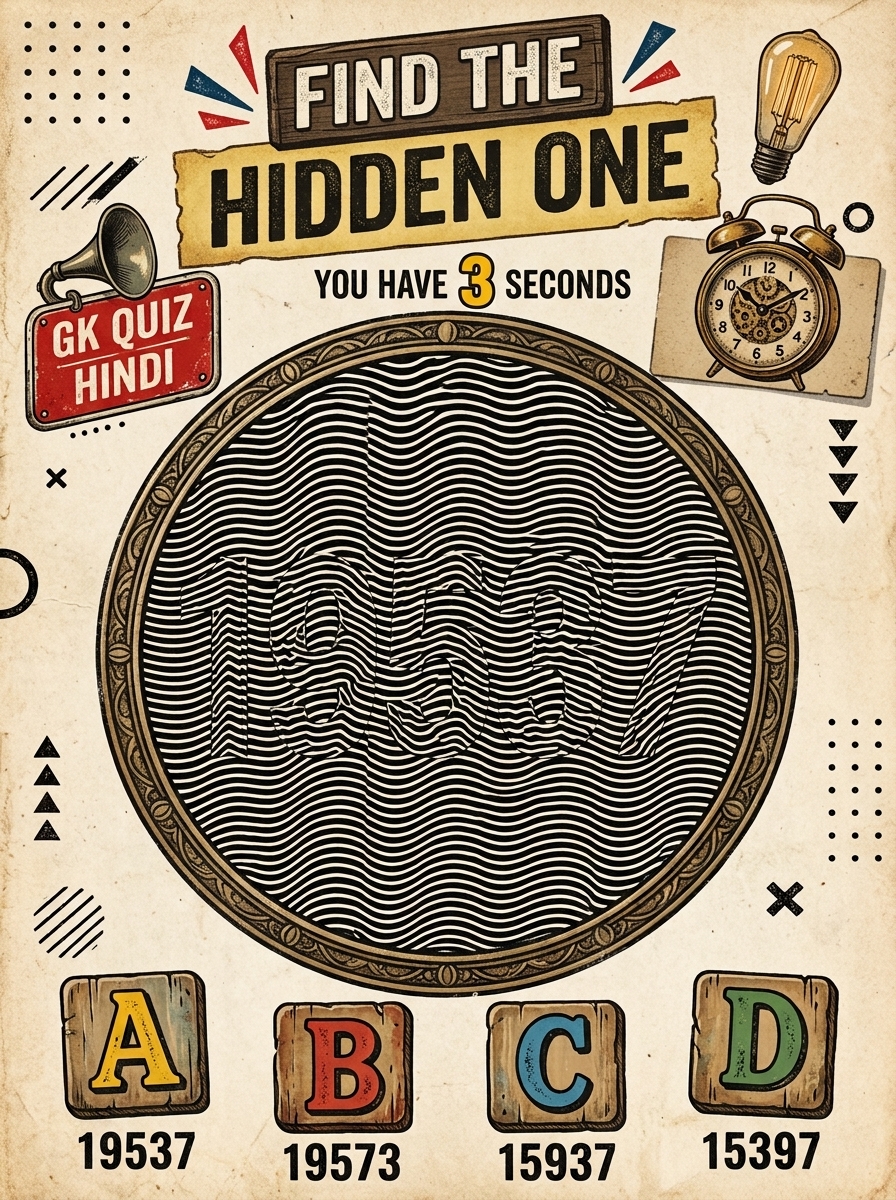
Optical illusions and visual puzzles have captivated human imagination for centuries. From ancient artwork to modern social media challenges featuring hidden numbers and optical tricks, these intriguing tests do much more than offer momentary entertainment. They reveal the intricate inner workings of the human brain, highlighting the complex relationship between visual perception, cognitive processing speed, and attention mechanisms. When presented with a hidden pattern embedded inside complex line art or high-contrast textures, the brain engages in a fascinating struggle to separate signal from noise.
1. Understanding Visual Perception: How We See
Human sight is often misunderstood as a simple process similar to taking a photograph. In reality, vision is an active, constructive process managed by the central nervous system. When light hits the retina at the back of the eye, photoreceptor cells convert light signals into electrical impulses. These impulses travel through the optic nerve to the primary visual cortex located in the occipital lobe at the back of the brain.
Once signal data reaches the visual cortex, the brain does not merely display an exact feed of the external world. Instead, it interprets, filters, and predicts incoming data based on past experiences, contrast, edge detection, and spatial awareness.
Key Factors in Visual Interpretation
-
Edge Detection: The visual cortex relies heavily on contrasts in brightness and color to establish boundaries between objects and backgrounds.
-
Gestalt Principles: The brain naturally groups similar elements, recognizes continuous lines, and fills in missing visual information to form complete shapes.
-
Figure-Ground Organization: Visual processing automatically separates an image into a dominant subject (the figure) and an underlying background (the ground).
When an image intentionally distorts these factors—using dense wave patterns, low-contrast outlines, or optical noise—the brain’s automatic recognition systems are challenged, forcing higher-level cognitive processing to intervene.
2. The Science Behind Optical Illusions and Hidden Number Puzzles
Optical illusions exploit gaps in the brain’s visual processing algorithms. Hidden number puzzles, such as those featuring wavy lines or high-frequency grid patterns, manipulate contrast and pattern recognition mechanisms to hide embedded digits.
+-----------------------------------------------------------------------+
|                         VISUAL PROCESSING FLOW                        |
|                                                                       |
|  [ Visual Input ]  --->  [ Primary Cortex ]  --->  [ Cognitive Parsing ] |
|  (Light & Contrast)       (Edge Detection)         (Pattern Recognition)|
+-----------------------------------------------------------------------+
Contrast and Spatial Frequency Masking
In hidden-number visual challenges, numbers are often outlined with subtle tonal variations or embedded directly within high-spatial-frequency noise (such as tightly packed black-and-white wavy lines). High-spatial-frequency patterns create intense visual activity in the visual cortex, effectively “masking” the lower-contrast contours of the hidden numbers.
To detect the hidden digits:
-
The visual cortex must filter out repetitive background noise (the wavy lines).
-
The parietal and frontal lobes must focus visual attention selectively on slight deviations in line curvature or brightness.
-
The brain synthesizes these micro-contrast changes into recognizable numerical shapes (e.g., detecting the sequence 1-9-5-3-7).
3. The Psychology of Cognitive Speed and Visual Agility
Many online puzzles feature tight time constraints—often challenging users to solve a visual task in three to five seconds. While these brief timers add an element of gamification, they also measure real cognitive processes, including visual processing speed, executive control, and selective attention.
Visual Processing Speed
Visual processing speed refers to the rate at which an individual can take in, digest, and respond to visual information. It is a fundamental component of cognitive efficiency and varies based on several factors:
| Cognitive Factor | Impact on Visual Problem-Solving |
| Selective Attention | The ability to focus on specific visual cues while ignoring ambient visual noise. |
| Working Memory | Holding temporary visual fragments in mind to assemble the complete image. |
| Neural Plasticity | The brain’s ability to adapt and improve pattern detection through practice. |
The Role of Micro-Saccades
When looking at a complex visual puzzle, the eyes do not remain completely still. They make tiny, rapid movements known as saccades and micro-saccades. These rapid movements sweep across the visual field several times per second, collecting high-resolution snapshots that the brain stitches together. Under tight time constraints, individuals who excel at visual puzzles often demonstrate more efficient saccadic movement patterns, rapidly targeting areas where line orientation changes.
4. Why Brain Teasers and Puzzles Are Popular Worldwide
Visual challenges, general knowledge quizzes, and optical puzzles enjoy massive popularity across global digital platforms. Their universal appeal can be explained through several psychological and neurological drivers:
Dopamine and the “Aha!” Moment
When a person successfully resolves an ambiguous visual puzzle—such as finally spotting a hidden number hidden behind dense lines—the brain experiences a sudden shift in perception known as insight, or the “Aha!” moment. This cognitive transition is accompanied by a release of dopamine, a neurotransmitter associated with pleasure, motivation, and reward. This neurochemical feedback loop makes solving puzzles intrinsically satisfying.
Accessible Cognitive Engagement
Unlike text-heavy puzzles or complex mathematical equations, visual optical illusions transcend language and cultural barriers. A visual pattern puzzle can be understood instantly by viewers worldwide, making it an ideal medium for broad engagement and shared digital experiences.
5. How to Train Your Brain to Solve Visual Puzzles Faster
While visual processing speed is partly innate, visual acuity and pattern recognition skills can be honed with practical strategies.
           +---------------------------------------------+
           |     STRATEGIES FOR OPTICAL PUZZLE SOLVING   |
           +---------------------------------------------+
           | 1. Soft Focus / Peripheral Vision Expansion |
           | 2. Viewing Distance Adjustment              |
           | 3. Angle Tilt and Micro-Contrast Filtering  |
           +---------------------------------------------+
Techniques for Decoding Hidden Images
-
Defocusing the Eyes (Soft Focus): By relaxing focus slightly rather than staring intently at a single spot, you reduce the impact of high-frequency visual noise (the fine wavy lines) and allow lower-frequency structural shapes (the hidden numbers) to emerge.
-
Changing the Viewing Distance: Moving back from the screen or shrinking the image size reduces spatial frequency, allowing the overall contours of hidden digits to become clearer.
-
Tilting the Perspective: Viewing an illusion from an oblique angle alters how light and contrast hit the visual receptors, often breaking the masking effect created by background lines.
-
Scanning for Edge Discontinuities: Instead of searching for complete numbers, scan the image specifically for places where the regular flow of background waves curves abruptly or changes density.
Conclusion: The Power of Visual Perception
Visual puzzles and optical illusions do much more than test our patience; they offer a window into the complex mechanisms of human perception. By combining spatial frequency masking, contrast manipulation, and cognitive pattern recognition, these brain teasers demonstrate how actively our minds work to construct reality from visual inputs. Whether solved in three seconds or thirty, deciphering hidden images remains a compelling exercise for the mind, illustrating the impressive capabilities of human visual processing.