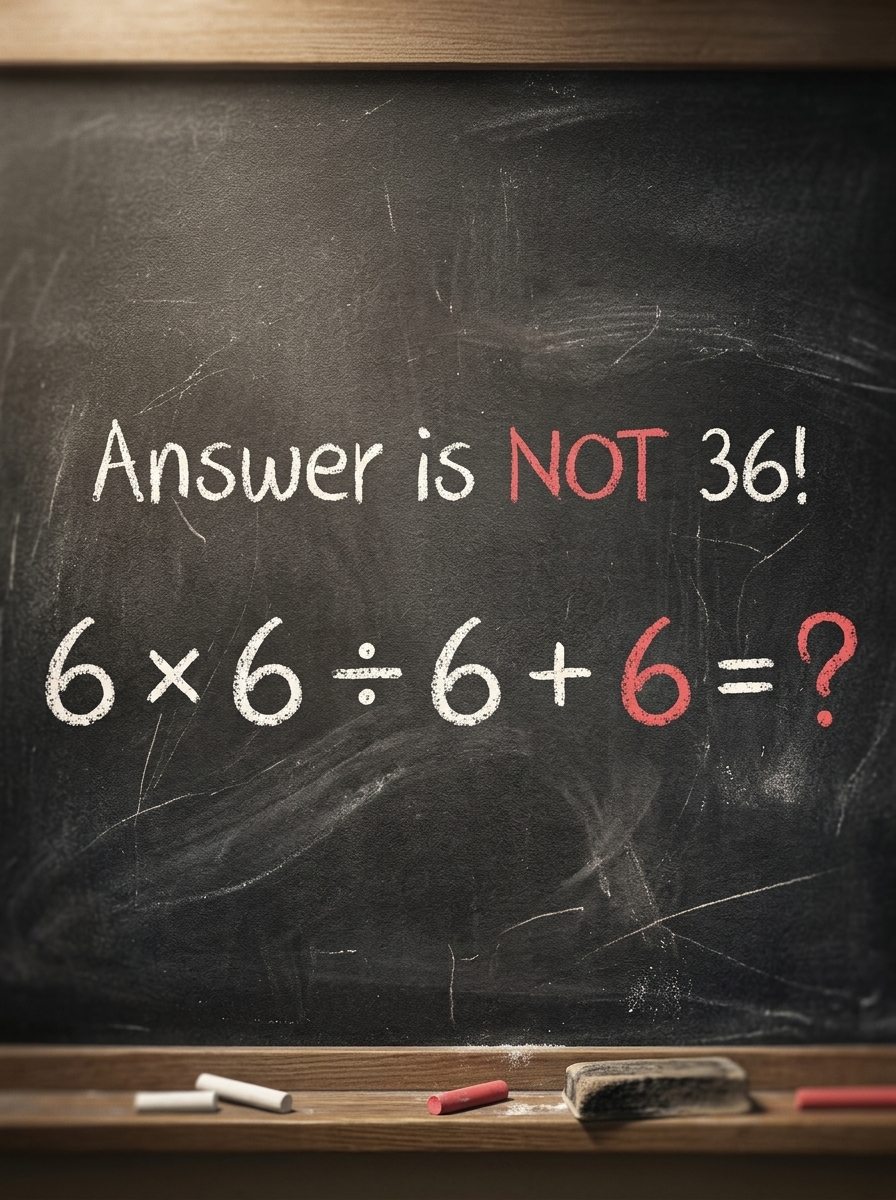
Viral arithmetic problems frequently circulate across social media platforms, sparking heated debates among millions of users. A classic example features a seemingly straightforward equation:
Accompanied by bold claims such as “The answer is NOT 36,” these visual puzzles capitalize on common mathematical misconceptions, operator precedence confusion, and left-to-right cognitive biases. While such equations appear elementary at first glance, they highlight fundamental principles of mathematical notation, cognitive psychology, and digital engagement.
1. Step-by-Step Mathematical Solution
To determine the correct value of the expression, standard mathematical conventions must be applied. The universal framework for evaluating arithmetic expressions relies on operator precedence rules, commonly known by acronyms such as PEMDAS (Parentheses, Exponents, Multiplication and Division, Addition and Subtraction) or BODMAS (Brackets, Orders, Division and Multiplication, Addition and Subtraction).
Applying Standard Rules
In the equation $6 \times 6 \div 6 + 6$:
-
Identify the Operations: The expression contains multiplication ($\times$), division ($\div$), and addition ($+$).
-
Determine Priority: Multiplication and division hold equal priority over addition. When operations of equal priority appear consecutively, they must be evaluated strictly from left to right.
-
Execute Left-to-Right Multiplication and Division:
-
First, evaluate the leftmost multiplication:
$$6 \times 6 = 36$$ -
Next, proceed to the division with the result:
$$36 \div 6 = 6$$
-
-
Execute Addition:
-
Finally, add the remaining term to the result:
$$6 + 6 = 12$$
-
The mathematically correct answer is 12.
2. Analyzing Common Mistakes and Cognitive Traps
Why do thousands of social media users arrive at incorrect results such as 36, 3, or 1? The errors stem from specific cognitive shortcuts and structural misinterpretations.
The Left-to-Right Grouping Fallacy
Many individuals process arithmetic equations in the exact manner they read written text: strictly left to right without applying hierarchical rules.
-
Incorrect Method A: A user might perform $6 \times 6 = 36$, then mistakenly view the remaining expression as requiring no further division, or incorrectly group terms as $(6 \times 6) \div (6 + 6) = 36 \div 12 = 3$.
-
Incorrect Method B: Some users perform addition before division, grouping the ending as $6 \div (6 + 6) = 6 \div 12 = 0.5$, leading to $36 \times 0.5 = 18$.
| Calculated Result | Error Type | Cause of Miscalculation |
| 12 | Correct | Applied standard order of operations (Left-to-Right for $\times$ and $\div$, then $+$). |
| 36 | Incorrect | Misreading operators or ignoring the final addition step. |
| 3 | Incorrect | Grouping addition first: $36 \div (6 + 6) = 36 \div 12$. |
| 1 | Incorrect | Incorrectly pairing factors: $(6 \times 6) \div (6 \times 6)$ variation assumptions. |
3. The History and Necessity of Order of Operations
The order of operations is not an arbitrary set of rules invented to confuse students; it is a vital mathematical convention designed to ensure unambiguous communication. Without standardized operator precedence, a single written expression could yield multiple conflicting values depending on the reader’s choice of order.
Historical Evolution
Historically, mathematical notation evolved over centuries. During the 16th and 17th centuries, as algebraic notation became more formalized, mathematicians recognized that multiplication naturally represents repeated addition. Consequently, multiplication inherently binds more tightly to its factors than simple addition does.
For instance, the expression:
represents two units added to three groups of four units ($2 + 12 = 14$). Performing addition first would alter the structure to five groups of four ($5 \times 4 = 20$), distorting the underlying physical reality the notation represents.
4. Psychological Factors Behind Viral Math Debates
Social media platforms are ideal environments for viral math puzzles. The rapid sharing of these challenges relies on several distinct psychological mechanisms.
Cognitive Overconfidence and Intuitive Processing
Psychologist Daniel Kahneman introduced the concepts of System 1 and System 2 thinking:
-
System 1 (Fast, Intuitive): Operates automatically with minimal effort. When looking at $6 \times 6 \div 6 + 6$, System 1 sees repeating sixes and instantly attempts to shortcut the calculation, often leading to rapid, incorrect assumptions.
-
System 2 (Slow, Analytical): Requires conscious mental effort. To solve the problem correctly, a person must suppress System 1 intuition and actively engage System 2 rules (PEMDAS/BODMAS).
Because people naturally default to System 1 thinking, they feel highly confident in their immediate, intuitive answer. When presented with conflicting answers in comment sections, this overconfidence triggers a defensive impulse to argue, generating massive user engagement.
The Dopamine Reward of Social Validation
Resolving ambiguity releases dopamine in the brain. When users double-check their calculations and verify that 12 is indeed the mathematically sound answer, they experience cognitive satisfaction. Furthermore, correcting others online provides a sense of intellectual validation, driving increased comment counts and algorithmic visibility.
5. Modern Digital Notation and Calculators
A frequent source of public confusion regarding equations like $6 \times 6 \div 6 + 6$ arises from differences in how electronic devices process mathematical inputs.
Standard Calculators vs. Scientific Calculators
-
Basic Desk Calculators: Standard single-line calculators execute operations instantly as keys are pressed (immediate execution mode). Entering
6 * 6 / 6 + 6on a simple calculator yields results step by step, evaluating each step immediately without waiting for the full expression. -
Scientific Calculators and Search Engines: Modern scientific devices, programming languages (Python, C++, Java), and web search engines implement algebraic entry logic. They parse the entire equation prior to evaluation, automatically enforcing standard order of operations to output 12.
Conclusion
The viral arithmetic challenge $6 \times 6 \div 6 + 6 = 12$ serves as a clear demonstration of mathematical syntax and human cognition. While the arithmetic involved requires only elementary school concepts, the visual layout triggers intuitive processing errors that lead many to incorrect conclusions. Understanding operator precedence ensures consistency in scientific, engineering, and daily computational contexts, proving that strict adherence to rules is essential for clear mathematical communication.