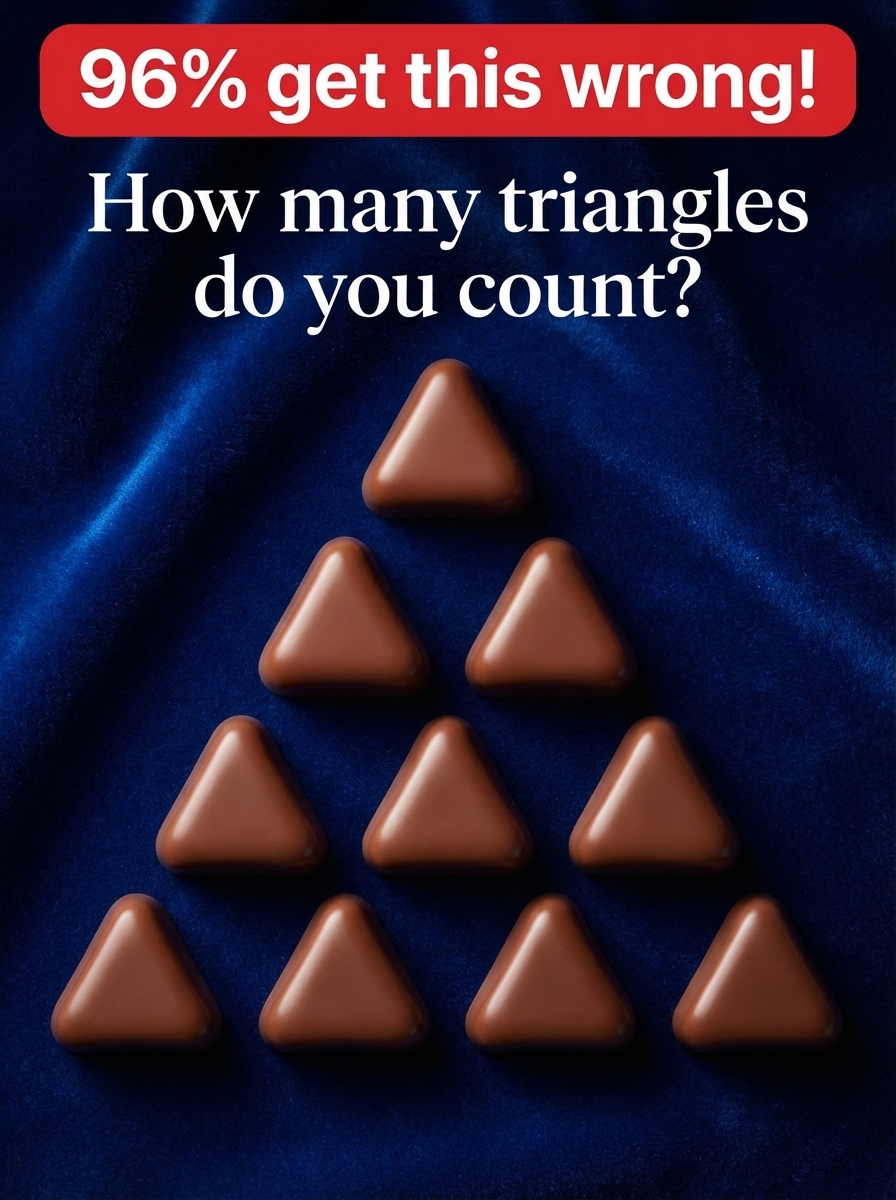
Counting puzzles featuring stacked geometric shapes—such as chocolate candies, coins, or blocks arranged in triangular grids—are among the most popular brain teasers across digital platforms. A classic example asks a deceptively simple question: “How many triangles do you count?”
Accompanied by bold claims such as “96% get this wrong!”, these visual challenges exploit fundamental differences between basic visual enumeration, systematic geometric counting, and spatial pattern recognition. While most viewers quickly tally the individual pieces visible on the surface, resolving the problem with complete mathematical accuracy requires understanding structural grouping, spatial hierarchy, and combinatorial logic.
1. Deconstructing the Puzzle: Mathematical and Geometric Solutions
To determine the exact number of triangles present in the image, the problem can be evaluated from two distinct analytical perspectives: individual object counting versus composite geometric shape recognition.
Solution 1: Physical Piece Enumeration (Direct Count)
In the primary interpretation of the image, the viewer is asked to count the physical triangular chocolate pieces arranged on the surface. The arrangement forms a classic triangular stack (or tetrahedral face layout) consisting of four distinct horizontal rows:
-
Row 1 (Top): 1 triangular piece.
-
Row 2: 2 triangular pieces.
-
Row 3: 3 triangular pieces.
-
Row 4 (Bottom): 4 triangular pieces.
Adding these individual elements yields a straightforward arithmetic summation:
Under this direct interpretation, there are 10 individual triangular chocolates.
Solution 2: Composite Geometric Triangle Counting
In advanced geometric counting puzzles, the term “triangle” refers not only to the individual standalone units, but also to larger composite triangular shapes formed by grouping smaller adjacent units together, as well as the overall triangular outline created by the entire stack.
Step-by-Step Composite Breakdown
-
Size 1 (Base Units): 10 individual triangular pieces ($1 + 2 + 3 + 4 = 10$).
-
Size 2 (Sub-Pyramids of 4 Units): Looking closely at the overlapping grid structure, smaller groups of four units (one top unit sitting above three base units) form larger triangular configurations.
-
Top sub-pyramid (Rows 1–2): 1 triangle.
-
Left sub-pyramid (Rows 2–3, left side): 1 triangle.
-
Right sub-pyramid (Rows 2–3, right side): 1 triangle.
-
Total Size 2 triangles = 3.
-
-
Size 3 (Sub-Pyramids of 9 Units): Larger groups of nine units forming a 3-row triangle:
-
Upper composite triangle (Rows 1–3): 1 triangle.
-
Total Size 3 triangles = 1.
-
-
Size 4 (Overall Macro Structure): The entire arrangement of all 10 chocolates forms one large overarching triangular pyramid profile:
-
Total Size 4 macro triangle = 1.
-
Depending on whether a puzzle’s key expects a direct physical piece tally or a full geometric composite count, the correct answer is either 10 or 15.
2. Triangular Numbers and Combinatorial Mathematics
The pattern formed by stacking objects in rows where each row contains one more unit than the previous is a fundamental concept in number theory known as Triangular Numbers.
The Mathematics of Triangular Sums
The sequence of triangular numbers ($T_n$) represents the total number of items needed to construct an equilateral triangle with $n$ items per side. The formula for the $n$-th triangular number is defined as:
For a four-row arrangement ($n = 4$):
In mathematics, the sum of consecutive triangular numbers generates the Tetrahedral Numbers ($E_n$), which count the total number of composite triangles present in a triangular grid:
Evaluating for a 4-level structure ($n = 4$):
However, because the chocolates are rounded individual pieces separated by subtle background gaps rather than intersecting continuous lines, inverted sub-triangles (negative spaces between pieces) are excluded, leaving 15 upright composite shapes.
3. Cognitive Psychology: Subitizing vs. Counting
Why do visual puzzles like this generate widespread errors and online disagreement? The answer lies in how human cognitive systems process visual quantities.
The Subitizing Threshold
Human beings possess an innate cognitive ability called subitizing—the rapid, accurate, and confident judgment of small numbers of items without counting them one by one.
-
Quantities of 1 to 4: Processed almost instantaneously by the visual cortex with virtually 0% error rate.
-
Quantities Greater Than 4: Exceed the subitizing limit, forcing the brain to switch from instant perception to active, sequential counting (serial processing).
When viewing a four-row triangle, the top two rows ($1 + 2 = 3$) fall within the subitizing range, while the bottom two rows ($3 + 4 = 7$) require active counting. If an observer rushes through the visual scan, System 1 cognitive processing shortcuts lead to skipping items, miscalculating row totals, or missing composite groupings altogether.
4. Psychological Factors Behind Viral Puzzle Engagement
Visual riddles paired with bold social claims—such as “96% get this wrong!”—are specifically designed to maximize user interaction across digital media platforms.
| Engagement Trigger | Psychological Mechanism | Effect on User Behavior |
| Provocative Headlines | Competitive Challenge & Ego Threat | Drives users to prove their intelligence by solving the problem. |
| Dual Valid Answers | Ambiguous Framing (10 vs 15) | Creates opposing opinions, generating active comment section debates. |
| Visual Simplicity | Low Cognitive Friction | Encourages immediate participation from broad audiences. |
The Mechanics of Comment Section Debates
Because the puzzle can be interpreted as either a count of physical objects (10) or a count of all geometric triangular structures (15), two distinct groups of users emerge in discussion forums. One group defends the literal piece count, while the second group defends the abstract geometric count. This structural ambiguity drives thousands of comments, triggering platform algorithms to push the content to wider audiences.
5. Systematic Strategies for Solving Spatial Counting Puzzles
To ensure complete accuracy when approaching spatial counting puzzles, a structured methodology should be employed:
-
Define the Target: Determine whether the prompt asks for physical individual objects or all possible geometric combinations.
-
Establish a Row Grid: Count the units systematically row by row from top to bottom rather than scanning randomly.
-
Apply Mathematical Formulas: For standard triangular stacks, verify the direct piece count using the triangular number formula $T_n = \frac{n(n + 1)}{2}$.
-
Audit Composite Scale: Work systematically through scale sizes (1×1, 2×2, 3×3, 4×4) to identify overlapping composite shapes without double-counting.
Conclusion
Counting puzzles like this chocolate triangle challenge demonstrate the rich intersection between elementary geometry, combinatorial mathematics, and visual perception. While a quick superficial glance might lead to miscounts, applying structured evaluation reveals that the image contains 10 individual triangular chocolates, which together form 15 distinct upright triangular shapes. Recognizing both the physical and structural answers highlights the importance of analytical precision when processing visual data.