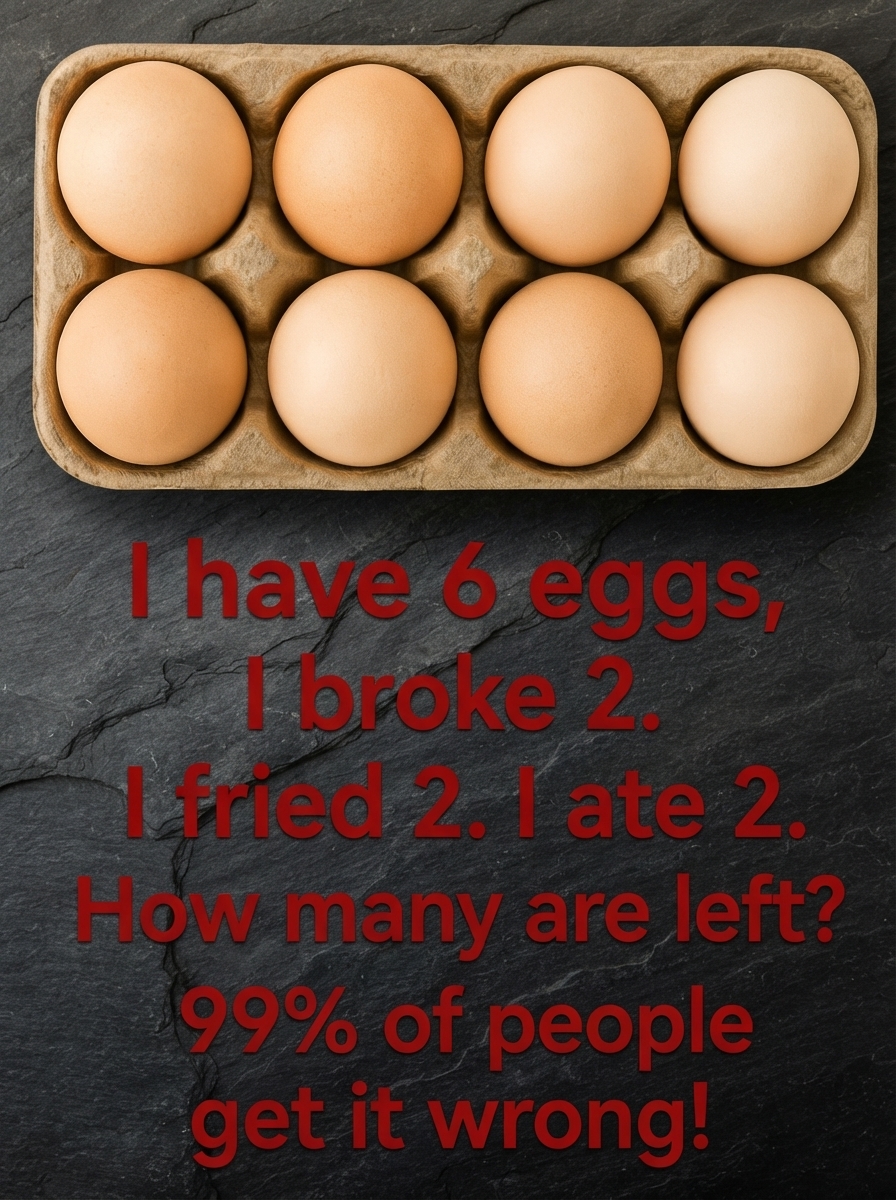
Riddles and linguistic brain teasers have long served as engaging exercises in cognitive psychology, semantics, and lateral thinking. Among the most widely shared word puzzles on social media is the famous egg riddle:
“I have 6 eggs. I broke 2. I fried 2. I ate 2. How many are left?”
Accompanied by bold assertions such as “99% of people get it wrong,” this brief riddle triggers intense debates online. While the arithmetic seems simple at first glance, the riddle relies on grammatical tense, chronological sequencing, and implicit assumptions to misdirect the reader. Analyzing this puzzle reveals key insights into how the human brain processes language, constructs mental models, and interprets semantic ambiguity.
1. Deconstructing the Riddle: The Logical and Linguistic Solutions
To determine how many eggs remain, one must examine the sentence structure, verb tenses, and physical relationships between the actions described.
Interpretation A: The Sequential Process (Standard Correct Answer)
The primary reason 4 eggs are left lies in the physical steps required to prepare and eat eggs:
-
Initial State: The statement begins with “I have 6 eggs” (present tense).
-
Step 1 (Breaking): To fry an egg, one must first crack its shell. Breaking 2 eggs reduces the uncracked count, but those 2 eggs are not destroyed; they are prepared for cooking.
-
Step 2 (Frying): The 2 eggs that were broken are the exact same 2 eggs that are fried.
-
Step 3 (Eating): The 2 eggs that were fried are the exact same 2 eggs that are eaten.
Under this logical sequence, the verbs broke, fried, and ate describe sequential actions performed on the same pair of eggs. Therefore:
Four whole, intact eggs remain in the carton, while two eggs have been prepared and consumed.
Interpretation B: The Cumulative View (Alternative Logic)
If the actions described are interpreted as entirely independent events occurring at different times, a different mathematical conclusion emerges:
-
2 eggs were broken and discarded.
-
2 separate eggs were fried.
-
2 additional eggs were eaten raw or prepared differently.
In this scenario, all six eggs were acted upon separately ($2 + 2 + 2 = 6$), leaving 0 eggs. However, because cooking naturally requires cracking and eating, standard linguistic framing assumes a unified action sequence rather than three disconnected events.
Interpretation C: The Grammatical Tense Distinction
A subtle grammatical detail lies in the shift between tenses:
-
“I have 6 eggs” uses the present tense, establishing the current inventory.
-
“I broke… I fried… I ate…” uses the simple past tense, referring to past actions.
If the past actions occurred prior to the present moment (for instance, yesterday), the current inventory of 6 eggs remains completely untouched, meaning all 6 eggs are left. However, in common riddle parlance, the past tense clauses are understood to describe the recent transformation of the initial supply.
2. Psycholinguistics: Why Brain Teasers Trick the Mind
The “6 Eggs” riddle is a classic example of a garden-path constraint combined with cognitive bias. Psycholinguistics studies how structural patterns in language influence cognitive parsing and decision-making.
The Addition Heuristic
When readers encounter a series of numbers within a problem ($6, 2, 2, 2$), the brain’s automatic processing system (System 1) instinctively attempts a simple arithmetic calculation:
Because System 1 favors speed and low effort, it skips the semantic step of evaluating whether “breaking,” “frying,” and “eating” are redundant operations performed on the same items. The reader assumes each verb applies to a new set of objects, falling into the trap of calculating zero remaining eggs.
Semantic Ambiguity and Ellipsis
In natural language, speakers frequently omit repetitive details—a phenomenon known as ellipsis.
-
Explicit Statement: “I broke 2 eggs, then I fried those same 2 eggs, and then I ate those 2 eggs.”
-
Elliptical Statement: “I broke 2. I fried 2. I ate 2.”
Because the riddle uses elliptical phrasing, it leaves room for the mind to mistakenly fill in the missing information with separate quantities (“I broke 2 other eggs…”).
3. The Role of Visual Context in Puzzles
In digital formats, visual riddles are almost always paired with an accompanying graphic—such as a cardboard carton holding eight or six whole eggs.
| Visual Element | Psychological Impact | Effect on Reader |
| Carton of Whole Eggs | Anchors the present state visually. | Reinforces the starting baseline of intact eggs. |
| Uniform Egg Imagery | Creates visual repetition. | Diverts attention away from functional state changes (cracked vs. cooked). |
| Bold Text Overlays | Triggers competitive motivation. | Accelerates reading speed, increasing System 1 errors. |
Visual cues can either aid or hinder problem-solving. When an image displays a full carton of eggs alongside the text, it creates cognitive dissonance between the static image (showing uncracked eggs) and the dynamic narrative (describing broken and cooked eggs).
4. Viral Mechanics and Social Media Engagement
Riddles like the “6 Eggs” challenge are engineered for maximum virality across social platforms. Their success relies on specific psychological drivers:
Debate and Comment Section Polarization
Because the riddle permits multiple interpretations based on grammatical parsing, it creates two distinct camps of commentators:
-
Camp A (Answer: 4): Focuses on practical kitchen logic (breaking and frying the same eggs).
-
Camp B (Answer: 0 or 6): Focuses on strict mathematical subtraction or literal past-tense distinctions.
When users encounter opposing answers in the comment section, they feel compelled to justify their logic. This high volume of replies and counter-arguments signals strong engagement to platform algorithms, boosting the post’s visibility to a broader audience.
The Superiority Effect and Gamification
Asserting that “99% of people get it wrong” introduces a challenge to the reader’s intellect. Arriving at the correct answer produces a brief dopamine release and a sense of intellectual superiority, encouraging the user to share the riddle with friends or colleagues to test their perception.
5. Practical Frameworks for Solving Linguistic Puzzles
To solve semantic riddles and word problems accurately, systematic analytical steps can be applied to avoid cognitive traps:
-
Map the Timeline: Separate past actions from present states. Identify whether events occur in sequence or concurrently.
-
Trace Object Identity: Determine whether pronouns or implied nouns refer to the same physical entities or distinct sets.
-
Verify Physical Feasibility: Cross-reference the verbal description with real-world mechanical processes (e.g., assessing whether an egg must be broken before it can be fried).
-
Isolate Grammatical Tenses: Pay close attention to shifts between past, present, and future tenses within the sentence structure.
Conclusion
The “6 Eggs” riddle is a masterful demonstration of how simple language can create cognitive ambiguity. By leveraging elliptical phrasing, redundant action steps, and the brain’s tendency toward rapid mathematical shortcuts, the puzzle tricks readers into overcomplicating an elementary scenario. Whether evaluated through practical culinary logic or strict semantic analysis, the core sequence reveals that processing two eggs through breaking, frying, and eating leaves 4 eggs intact in the carton—proving that in linguistic puzzles, careful reading is just as important as mathematical calculation.