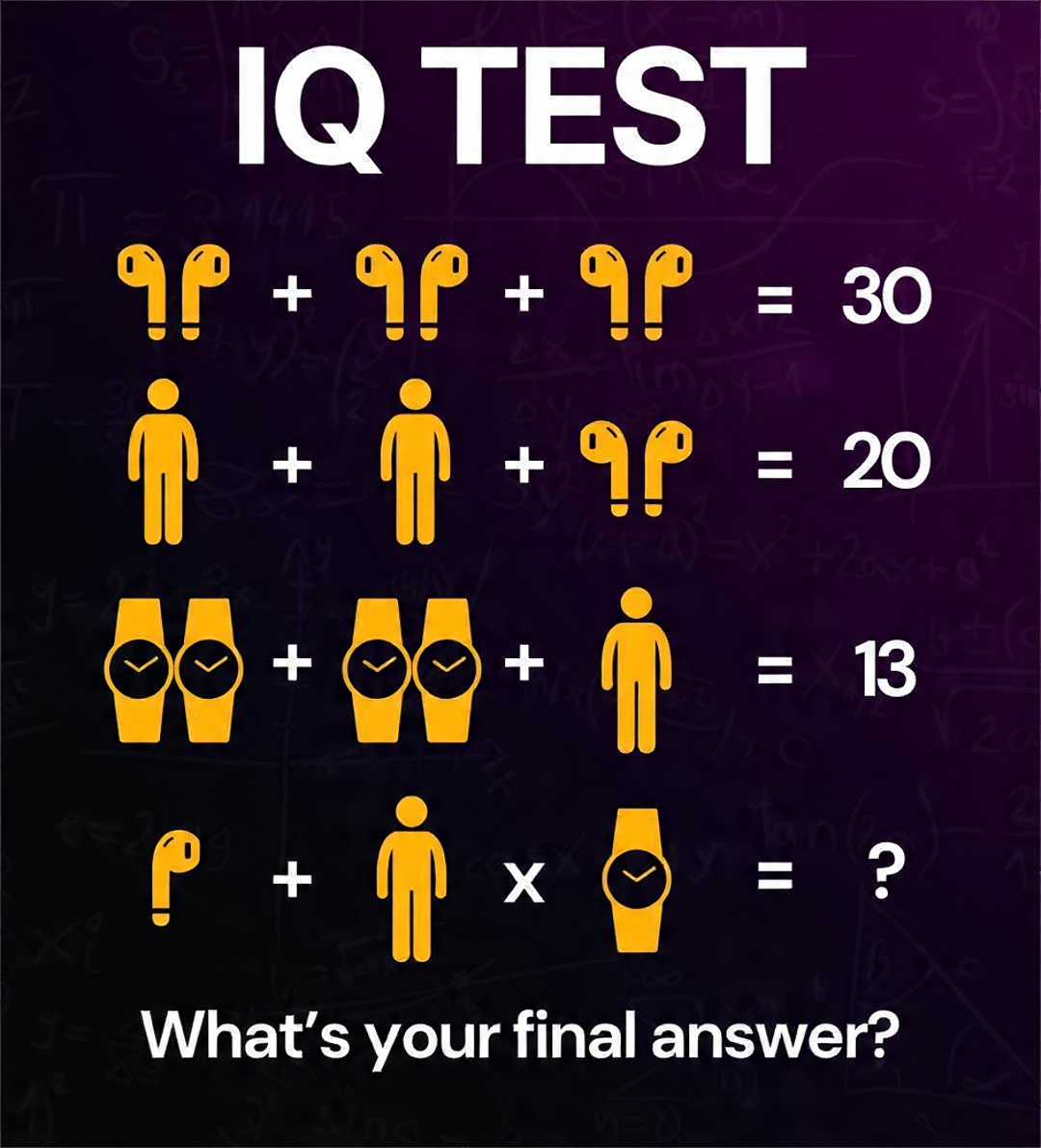
Here is a clean, paraphrased English walkthrough — same puzzle, clearer steps:
At first glance it looks easy. A few icons, some simple equations, and a final question mark. That simplicity is the trap. This puzzle tests logic, but even more, it tests attention to detail.
Let’s solve it step by step.
Step 1: The earbuds
Three identical pairs of earbuds add to 30.
Earbuds + Earbuds + Earbuds = 30
3 × pair = 30
One pair of earbuds = 10
Step 2: The person
Person + Person + Earbuds = 20
We know the earbuds pair is 10.
Person + Person + 10 = 20
2 × Person = 10
One person = 5
Step 3: The watches
(Pair of watches) + (Pair of watches) + Person = 13
Person is 5.
2 × watch-pair + 5 = 13
2 × watch-pair = 8
One pair of watches = 4
So a single watch is half of that:
One watch = 2
Step 4: The final line — look closely
The last expression is:
Single earbud + Person × Single watch
Notice the changes:
- It is not a pair of earbuds anymore, it is one. If a pair is 10, then one earbud is 5.
- The person is the same base value, 5. (In some versions check for missing headphones or watches on the person — here the value stays 5.)
- It is not a pair of watches, it is one. One watch = 2.
So the expression becomes:
5 + 5 × 2
Step 5: Order of operations
Multiplication first.
5 × 2 = 10
5 + 10 = 15
Final answer: 15
Why people get it wrong
- They treat a single earbud as a full pair
- They miss that a pair of watches became one watch
- They add before multiplying
This is not hard math. It is visual discipline.
What it says about you
If you got 15:
- You check details instead of assuming
- You follow logic step by step
- You resist autopilot
If you missed it:
- You likely rushed the last line
- You trusted the pattern instead of verifying the images
The real lesson is not about numbers. It is about consistency. The biggest trap is not complexity. It is thinking something is simple when it is not.
You did not just solve a puzzle. You showed whether you observe carefully and think structurally. That skill matters far beyond one brain teaser.