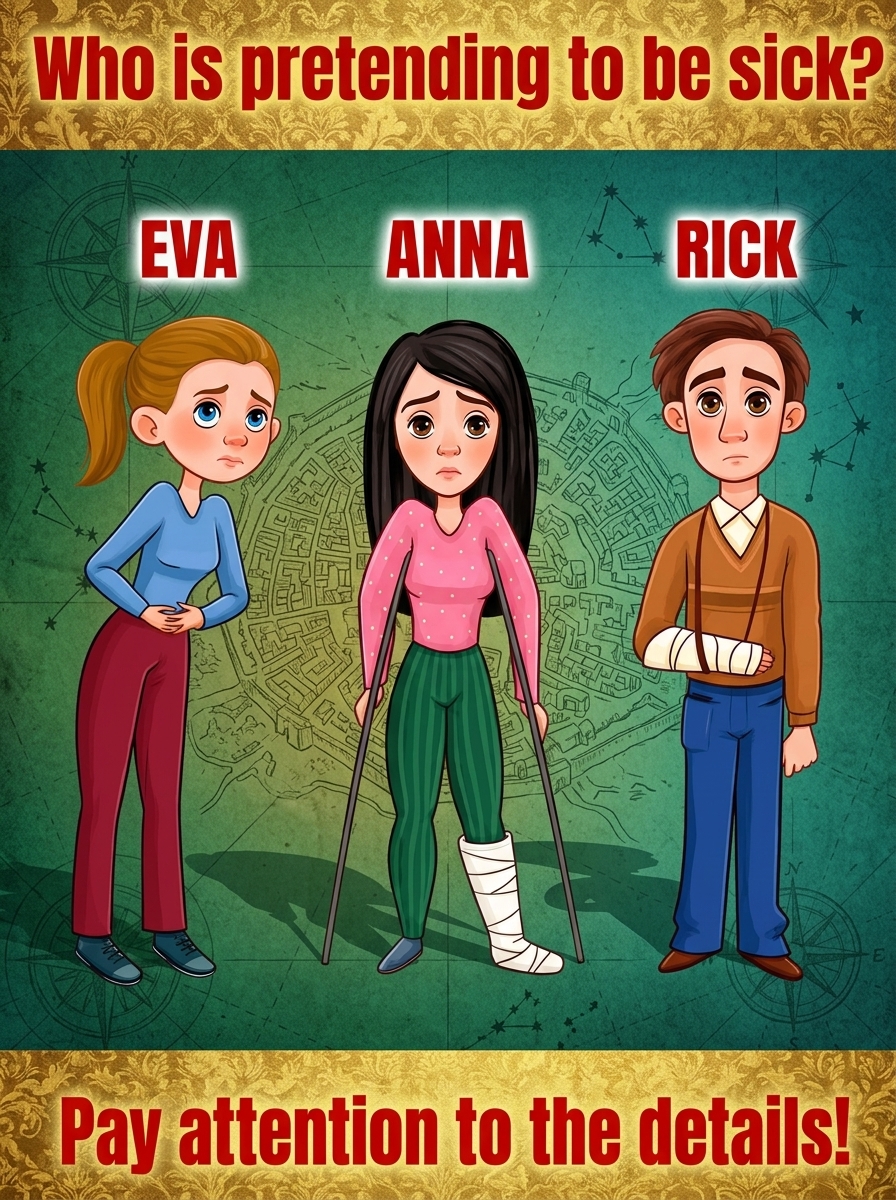
Observational riddles and visual deduction puzzles represent a unique category of cognitive exercises. Unlike pure logic puzzles that rely solely on mathematical operations or word-based riddles that exploit linguistic ambiguity, visual puzzles require the brain to process graphical information, identify structural anomalies, and apply real-world reasoning. A popular riddle asks a simple question: “Who is pretending to be sick?”
Featuring three individuals—Eva, Anna, and Rick—the image presents a set of visual cues designed to test an observer’s attention to detail, critical thinking, and deductive reasoning skills. Evaluating these visual elements requires an understanding of how the human brain processes visual detail, filters information, and resolves cognitive inconsistencies.
1. Visual Analysis and the Correct Answer
To uncover the correct answer, each character’s appearance, posture, and equipment must be analyzed against realistic physical and medical conditions.
Deconstructing the Evidence
-
Eva (Stomach Pain): Eva is depicted bending forward slightly, holding her stomach with both hands, and expressing discomfort through her facial expression. Her posture aligns with natural human physical responses to abdominal distress.
-
Anna (Leg Injury): Anna has a medical cast on her left leg and is using a pair of crutches placed under her arms to support her weight. The cast and supportive equipment match typical medical protocol for a lower-limb fracture or severe injury.
-
Rick (Arm Injury): Rick has a cast covering his right forearm. However, a closer look at the supporting sling reveals a major flaw: the sling strap goes around his neck, but it is not attached to the cast or holding his arm. Instead, his casted arm is hanging unsupported while the loop of the sling rests loosely around his chest and neck.
Because Rick’s sling is completely non-functional and incorrectly positioned—failing to support the weight of the cast—Rick is the person pretending to be sick.
2. The Science of Visual Observation and Inattentional Blindness
Visual deduction puzzles capitalize on key mechanisms of human perception. When individuals scan a complex image, they rarely inspect every square pixel with equal scrutiny. Instead, the visual system relies on heuristic shortcuts, selective attention, and schema-driven expectations.
Schema Activation and Visual Shortcuts
When looking at Rick, the human brain instantly registers recognizable visual landmarks: a brown sweater, a white cast around the forearm, and a brown strap resembling a sling. Upon recognizing these elements, the brain activates the mental “schema” for a broken arm.
-
Automatic Categorization: System 1 thinking immediately categorizes Rick as “injured” based on the presence of the cast and strap.
-
Inattentional Blindness: Because the overall scene fits the expected mental model, the mind often overlooks the crucial detail that the strap does not actually connect to or support the arm.
-
Analytical Override: To spot the trick, an observer must activate System 2 processing—deliberately overriding initial assumptions to verify whether the physical mechanics of the sling are correct.
3. Cognitive Benefits of Deductive Brain Teasers
Engaging regularly with visual riddles and spot-the-difference challenges provides valuable cognitive stimulation. These exercises engage multiple regions of the brain responsible for higher-level mental functions.
Enhancing Critical Thinking Skills
Visual deduction requires combining two primary modes of reasoning:
-
Observation (Data Gathering): Systematically inspecting an image for individual details, such as clothing, posture, and objects.
-
Inference (Hypothesis Testing): Testing gathered details against real-world logic and mechanical consistency.
| Cognitive Domain | Function in Visual Deduction | Long-Term Benefit |
| Selective Attention | Filtering out irrelevant visual information (clothing color, hair style). | Improved focus in information-dense environments. |
| Pattern Recognition | Comparing visual input with known physical standards (how slings work). | Faster identification of anomalies and errors. |
| Working Memory | Holding details about multiple subjects in mind simultaneously. | Enhanced mental processing capacity and problem-solving speed. |
4. Why Observational Puzzles Go Viral on Social Media
Visual riddles like “Who is pretending to be sick?” generate substantial engagement across digital platforms. Their viral nature is driven by several psychological factors:
Low Barrier to Entry with High Engagement
Visual puzzles do not require specialized vocabulary, translation, or advanced mathematical training. Anyone can participate instantly regardless of age or language background, making them universally accessible.
The Curiosity Gap and Gamification
The explicit instruction—“Pay attention to the details!”—creates a curiosity gap. It signals to the viewer that a hidden truth exists within the image, challenging their observational competence. The desire to test one’s perception against others drives high participation rates, comment section debates, and social shares.
5. Strategies for Solving Visual Deduction Riddles
To solve visual puzzles efficiently, a systematic observational methodology can be applied:
-
Examine Components Independently: Rather than viewing the scene as a single image, isolate each character and audit their individual elements from top to bottom.
-
Trace Mechanical Connections: In puzzles involving straps, ropes, shadows, or tools, physically trace the path of each item to verify that it connects logically to its destination.
-
Evaluate Real-World Functionality: Ask whether an object is functioning as intended by physical laws. A cast supported by nothing, a shadow cast in the wrong direction, or a reflection that does not match the subject are prime indicators of the solution.
Conclusion
Observational riddles serve as an engaging demonstration of human cognitive processing. By presenting a scenario where an obvious answer is hidden behind an everyday visual trap, puzzles like this challenge the brain to move past surface-level assumptions. In the case of Eva, Anna, and Rick, analyzing the functional mechanics of Rick’s arm sling reveals that he is the one pretending to be sick—proving that keen attention to detail is essential for accurate deduction.